Hitler's occupation of Czechoslovakia
The Glass RoomHitler’s occupation of Czechoslovakia arrives first as a forecast and then as a change in the conditions of ordinary life: military vehicles block the way to the railway station, German soldiers control movement, and the Landauer family’s departure becomes an encounter with an advancing regime. The occupation is not only an invasion witnessed in the street. It remakes borders and homes into instruments of authority, ultimately transforming the Landauer House from a private modernist residence into a Nazi biometric research centre.
Causes and Forewarning
The danger is legible before the occupation is fully visible. In the Landauer Villa’s Glass Room, the view of snow falling across a city and a continent under threat gives way to the question of whether the Germans will invade. The answer is that they need not invade in the conventional sense: they can wait until the moment suits them and simply walk in. Viktor tells Liesel that they must leave by March at the latest, because further delay could make escape impossible. The forecast sets the terms of what follows: the decisive force is not a dramatic battle in the family’s immediate surroundings but the steadily narrowing opportunity to get out.
The family’s earlier experience of border control already suggests how political change will be felt in daily life. On returning from Vienna, Rainer von Abt calls the newly established passport checks ironic: a world that claims to move forward has created a border where none existed before. Liesel answers that this is a small loss of freedom beside the freedoms gained. His question about whether she herself is free leaves that assurance unsettled. The occupation will make the discrepancy between abstract freedom and practical movement impossible to ignore.
The Occupation Reaches the City
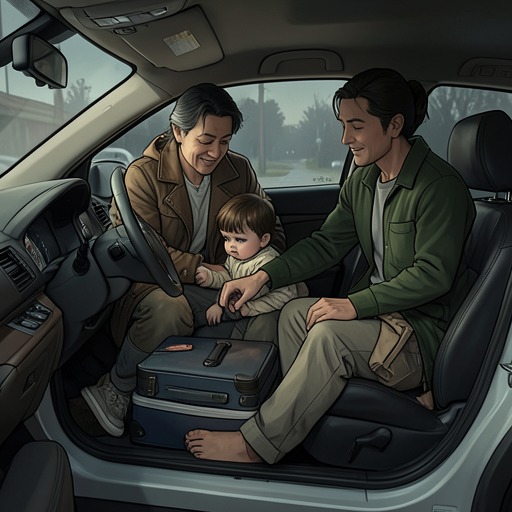
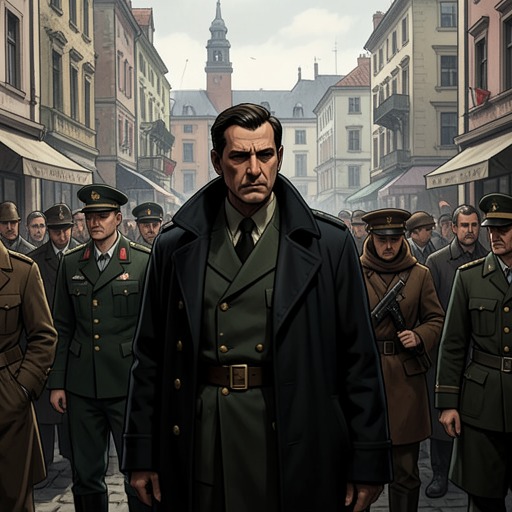
On Friday the seventeenth, the Landauers set out in a small convoy. Viktor and Liesel travel in the first car with the children; Katalin follows with Marika and the luggage, while Oskar and Hana bring up the rear. New rules require driving on the right. The almost empty streets and the convoy’s passage past the children’s hospital make the city feel suspended, but the road to the railway station is blocked by military vehicles. At the Grand Hotel, soldiers stop the cars. The uniform of the Feldgendarmerie is unfamiliar to the family, a visible sign that the authority controlling the street has changed.
The occupation becomes unmistakable when the soldiers react to the roar of engines. One leaves the car window and snaps to attention; another salutes. Viktor gets out to look, despite Liesel calling him back. An open-topped, six-wheel vehicle emerges from the station forecourt with Adolf Hitler standing at its front. The figure whose face has been familiar from newsreels and newspapers passes through the city in a motorcade, then roars away down Masaryk Street. People in the watching crowd weep, but the scene offers no certainty about whether the tears express joy or misery. The children, by contrast, look on with uncomprehending curiosity; Martin asks who the man was because he did not see him. The seizure of the city is thus registered at once as public spectacle and as a rupture whose meaning adults grasp more fully than children.
Flight, Documents, and Separation
The convoy’s departure is an effort to escape a country whose streets and regulations are changing around it. At the station, military control makes departure contingent on inspection. A German official demands documents, and Viktor arranges the papers in neat piles, identifying the group as himself, his wife, their two children, the children’s nanny, and her daughter. Passports, French transit visas, a Spanish visa, and train tickets are examined; even the tickets seem less a guarantee than a wager whose outcome is uncertain.
The paperwork does not protect everyone equally. When Katalin presents what she has, Viktor explains that she is in the family’s employ. The official rebukes him for speaking without being asked. After a brief consultation over Katalin’s passport and visas, an official takes her by the elbow and leads her away. Marika cries out for her mother; Liesel pulls the child close and promises that she is with them and will be looked after. The separation is then extended to Marika herself, who is pushed toward the hut where Katalin has been taken.
Viktor protests that Katalin’s documents are in order and identifies her refugee passport as a Nansen passport. He insists that it had been accepted when they left Czechoslovakia and that it is valid for travel through France and Spain. The German official threatens him with detention if he does not return to the train. The crowd behind the family presses forward, anxious not to attract attention or become the next people taken away. The official advises Viktor to move on and suggests that the delay may be temporary, but this assurance cannot undo the immediate division of the group. Soldiers push the family toward the carriage and remove Katalin and Marika’s suitcases. Their escape is therefore neither a clean departure nor a secure passage: possession of papers offers no certainty when officials control how those papers are interpreted.
The House Recast as an Instrument of Rule
The occupation’s remaking of the Landauer family’s life continues through the fate of their home. The house had grown alongside Liesel and Viktor’s baby: the child’s rapid milestones were set against the slower construction of steel beams, poured concrete, and enclosed space. Delays, shortages of materials and labour, and disputes stretched the building work through summer and autumn. Once the shell was completed, the family found no celebratory ceremony waiting for them. The winter structure initially looked more like a warehouse than a home, its new rooms bare, dusty, and lit by single bulbs. Its meaning as a residence had to be made through living in it; occupation later imposed another meaning by force.
Under Nazi administration, the former home is reorganized for racial measurement and documentation. Upstairs rooms become offices, the kitchens are converted into a laboratory, and a basement room is prepared for an X-ray machine. The Glass Room is divided with curtains; measuring devices, scales, callipers, a height stand, and a camera are arranged around the onyx wall and the curved Macassar panelling. The dining area becomes a photographic studio. Even the Bösendorfer piano remains, incongruously restored by a Jewish tuner, while the garage that once held the family’s two cars receives large German Hollerith machines and the building fills with files collected in Vienna. The contrast is stark: a house planned around light, space, and family life is made to process and classify human beings.
The building’s later uses confirm that occupation is one phase in a longer struggle over who controls space and what it is for. In the postwar period, the Landauer House serves as a children’s gymnasium, where Tomáš calls it the Glass Room and finds in it a place of light and stillness. A later report describes it as an architectural treasure in the Blackfield district, overlooking Lužánky Park and the city centre, and identifies it as Rainer von Abt’s masterpiece. After the fall of the Iron Curtain, repair work and the restoration of plate glass return some of its former lucid appearance. These later meanings do not cancel the occupation’s transformation of the residence; they make its successive appropriations visible. The same rooms have served a family, a coercive system of measurement, children receiving treatment, and visitors encountering a preserved architectural work.